Affiliate Disclosure: This article contains Amazon affiliate links (tag: seperts-20). If you click a link and make a qualifying purchase, HomeVibed may earn a small commission at no extra cost to you. Our editorial opinions are independent of affiliate compensation. Full disclosure →
How to Mix Metals in Home Decor Without It Looking Messy: The 2024 HomeVibed Guide
This article contains Amazon affiliate links. If you purchase through them, HomeVibed earns a small commission at no extra cost to you.
How to Mix Metals in Home Decor Without It Looking Messy: The 2024 HomeVibed Guide
Mixing metals in home decor is defined as the intentional incorporation of two or more distinct metallic finishes (e.g., brass, chrome, matte black, oil-rubbed bronze) within a single room or design scheme. This sophisticated design technique adds depth, visual interest, and a layered, curated feel to a space, moving beyond the monochromatic metallic looks of the past. For homeowners, mastering this skill allows for greater design flexibility, the ability to blend different eras and styles, and the creation of a truly personalized and dynamic interior that feels both modern and timeless.
Table of Contents
- The End of Monochromatic: Why Mixed Metals Are In
- Understanding Your Metal Palette: Warm, Cool, and Neutral
- The 60-30-10 Rule for Mixing Metals
- Strategic Placement: Where to Mix Metals Effectively
- Common Pitfalls and How to Avoid Them
- Mixing Metals Room by Room: Practical Applications
- Maintaining Cohesion: Bringing It All Together
The End of Monochromatic: Why Mixed Metals Are In
For decades, interior design often dictated a singular metallic finish for an entire room, sometimes even an entire home. Chrome fixtures, brass hardware, or brushed nickel everything – the rule was consistency above all else. While this approach offered a clean, uniform look, it often lacked personality and depth, sometimes feeling sterile or overly traditional. Today, design trends have embraced a more eclectic, layered aesthetic, and nowhere is this more evident than in the art of mixing metals. This shift isn't just a fleeting trend; it's a sophisticated design choice that adds visual complexity, character, and a sense of curated elegance to any space.
The Evolution of Metallic Trends
The journey from strictly matching metals to confidently blending them reflects a broader movement in interior design towards personalization and breaking rigid rules. Historically, certain metals were associated with specific eras or styles: polished brass with the 80s, chrome with mid-century modern, and oil-rubbed bronze with Tuscan or rustic aesthetics. As design evolved, homeowners began to crave spaces that felt less like a showroom and more like a reflection of their unique tastes and travels. This desire for individuality naturally led to experimenting with different textures and finishes, including metals. The rise of "transitional" and "eclectic" styles further solidified the acceptance, and even encouragement, of mixing and matching. Designers realized that a thoughtful blend of metals could bridge different design periods, making a space feel both timeless and contemporary. It allows for the integration of cherished antique pieces with modern finds, creating a dialogue between the old and new that a single metal finish simply cannot achieve.
Benefits of a Mixed Metal Palette
Embracing a mixed metal palette offers a wealth of advantages that go beyond mere aesthetics. Firstly, it adds incredible visual interest and depth. Just as a painter uses different colors and textures to create a dynamic canvas, a designer uses varied metallic finishes to prevent a room from falling flat. The interplay of reflective and matte, warm and cool, creates a nuanced environment that catches the eye and invites closer inspection. Secondly, it allows for greater flexibility and longevity in your design choices. When you're not locked into one metal, you have more freedom to incorporate new pieces, whether they're heirlooms, new purchases, or items you simply love, without worrying if they "match." This adaptability means your space can evolve with your tastes over time, reducing the need for costly overhauls. Thirdly, mixed metals can elevate a space, making it feel more luxurious and intentionally designed. It signals a confident design hand, one that understands how to balance elements to create harmony. Finally, it helps to break up monotony. Imagine a kitchen with all brushed nickel hardware, lighting, and appliances. While functional, it might lack a certain spark. Introduce some polished brass pendants or matte black cabinet pulls, and suddenly the space feels richer, more dynamic, and undeniably chic.
Overcoming the Fear of "Messy"
The primary apprehension homeowners face when considering mixing metals is the fear of their space looking "messy," "cluttered," or "uncoordinated." This concern is entirely valid, especially given the historical emphasis on uniformity. The key to overcoming this fear lies in understanding that successful metal mixing isn't about throwing random finishes together; it's about intentionality, balance, and applying a few guiding principles. Think of it less as a free-for-all and more like composing a symphony where different instruments play together harmoniously. The "messy" outcome usually stems from a lack of a clear strategy, too many competing finishes, or an imbalance in their distribution. By establishing a dominant metal, introducing a secondary accent, and using a unifying element, you can create a cohesive look that feels sophisticated, not chaotic. This guide will equip you with the practical tools and frameworks to confidently mix metals, transforming your home into a beautifully layered and personalized sanctuary.
Understanding Your Metal Palette: Warm, Cool, and Neutral
The foundation of successful metal mixing lies in understanding the inherent characteristics of different metals, particularly their undertones. Just like paint colors, metals can be categorized as warm, cool, or neutral, and knowing these distinctions is crucial for creating a balanced and harmonious scheme. When you grasp these fundamental properties, you can select metals that complement each other rather than clash, ensuring your mixed metal aesthetic feels intentional and sophisticated.
Warm Metals: Brass, Gold, Copper
Warm metals are those that evoke a sense of coziness, richness, and often a touch of vintage elegance. Their undertones lean towards yellow, orange, or red, bringing warmth and glow to a space.
- Brass: This is perhaps the most popular warm metal currently. Polished brass offers a bright, reflective golden hue, while unlacquered or antique brass provides a more subdued, aged patina. Brass pairs beautifully with cool tones like navy or emerald green, and also with natural materials like wood and leather. Its versatility makes it an excellent choice for a primary or secondary metal.
- Gold: Similar to brass but often perceived as more luxurious and refined, gold finishes (like polished gold or champagne gold) add immediate glamour. They work exceptionally well in formal settings or when you want to inject a sense of opulence. Gold can be a powerful accent and should often be used more sparingly than brass to maintain its impact.
- Copper: With its distinctive reddish-orange hue, copper brings a rustic, artisanal, or even industrial charm. It patinas beautifully over time, developing a rich, dark brown finish. Copper is fantastic for adding a unique, earthy warmth, especially in kitchens or spaces with exposed brick or natural wood. It can be a stunning accent metal, particularly when paired with matte black or brushed nickel.
Cool Metals: Chrome, Nickel, Stainless Steel
Cool metals are characterized by their silvery, blue, or grey undertones. They tend to create a sleek, modern, and often minimalist aesthetic, bringing a sense of crispness and clean lines to a design.
- Chrome: Known for its high-shine, mirror-like finish, chrome is a classic choice for contemporary and modern interiors. It reflects light brilliantly, making small spaces feel larger and brighter. Chrome is very durable and easy to clean, making it popular for bathroom fixtures and kitchen appliances. Its stark coolness can be softened by pairing it with warm metals or natural textures.
- Nickel (Brushed or Polished): Nickel offers a softer, slightly warmer silver tone compared to chrome. Brushed nickel has a matte, satin finish that hides fingerprints well and provides a subtle elegance. Polished nickel, while still cool, has a deeper, richer luster than chrome, often preferred in more traditional or transitional designs for a timeless look. Both forms of nickel are incredibly versatile and can act as excellent bridge metals between warm and cool palettes.
- Stainless Steel: Predominantly found in appliances, stainless steel has a muted, brushed silver-grey appearance. It's highly durable, resistant to corrosion, and conveys a professional, industrial-chic vibe. While often a functional necessity, its neutral cool tone makes it easy to integrate with almost any other metal finish.
Neutral Metals: Matte Black, Oil-Rubbed Bronze
Neutral metals don't lean heavily into warm or cool undertones, making them incredibly flexible and powerful unifying elements in a mixed metal scheme.
- Matte Black: This finish has exploded in popularity for its bold, sophisticated, and contemporary appeal. Matte black provides a strong contrast against lighter surfaces and acts as a grounding element. Because it lacks a strong metallic sheen, it reads almost as a color, allowing it to bridge warm and cool metals effortlessly. It can be paired with virtually any other metal, from polished brass to brushed nickel, creating a striking modern contrast.
- Oil-Rubbed Bronze (ORB): ORB is a dark, almost black finish with subtle copper undertones that peek through, giving it a rich, aged appearance. It's often associated with traditional, rustic, or Tuscan styles, but its deep, muted quality makes it surprisingly versatile. It can warm up cool palettes or add depth to warm ones. Its slightly textured, less reflective nature makes it a great choice for grounding a space without being overly flashy.
Key Takeaway: When mixing, aim for a balance. A common strategy is to pick one dominant warm metal and one dominant cool metal, or to use a neutral metal like matte black to tie everything together. For instance, brass (warm) and brushed nickel (cool) can be beautifully unified by matte black accents. Understanding these categories is your first step to creating a sophisticated, rather than messy, mixed metal look.
The 60-30-10 Rule for Mixing Metals
Just as with color palettes, applying a proportional rule to your metal choices can prevent your space from feeling chaotic or unbalanced. The 60-30-10 rule provides a clear, actionable framework for distributing your chosen metals throughout a room, ensuring a harmonious and intentional design. This isn't a rigid law, but a flexible guideline that helps you create visual hierarchy and cohesion.
Step 1 of 3: Choose Your Dominant Metal (60%)
The first and most crucial step is to select one metal finish that will serve as the primary player in your room. This metal will occupy approximately 60% of your metallic elements, providing a strong foundation and a sense of continuity.
- Selection Criteria: Your dominant metal should be one you genuinely love and that aligns with the overall style and mood you want to create in the room. Consider its functionality and how easily it integrates with existing elements. For instance, if you have a lot of stainless steel appliances in your kitchen, stainless steel might naturally become your dominant metal. In a living room, perhaps you love the warmth of brass, so it becomes your primary.
- Where to Apply: The dominant metal should appear on the largest or most numerous metallic surfaces. This could include:
- Major light fixtures (e.g., a large chandelier, ceiling fan)
- Door hardware (handles, hinges)
- Plumbing fixtures (faucets, showerheads)
- Large furniture accents (e.g., a coffee table with a metal base, a console table)
- Appliance finishes (especially in kitchens)
- Window hardware (curtain rods)
- Example: In a bathroom, if you choose brushed nickel as your dominant metal, your faucet, showerhead, towel bars, and cabinet pulls would all be brushed nickel. This establishes a clear base.
Step 2 of 3: Introduce Your Secondary Metal (30%)
Once your dominant metal is established, select a secondary metal that will complement it, making up about 30% of your metallic elements. This metal should offer a pleasing contrast or a harmonious blend with your dominant choice, adding depth without competing.
- Contrast or Complement:
- For Contrast: If your dominant metal is cool (e.g., brushed nickel), your secondary metal could be warm (e.g., polished brass or matte gold). This creates dynamic tension and visual interest.
- For Complement: If your dominant metal is neutral (e.g., matte black), your secondary metal could be either warm or cool, depending on the desired effect. For example, matte black with brushed nickel offers a sleek, modern look, while matte black with brass offers a sophisticated, contemporary contrast.
- Where to Apply: The secondary metal should be used on medium-sized elements or in places where it can make an impact without overpowering the dominant metal. This might include:
- Smaller light fixtures (e.g., sconces, table lamps)
- Cabinet hardware (if different from door hardware, though consistency is often preferred here)
- Mirror frames
- Picture frames
- Decorative objects (vases, trays)
- Furniture legs or small accents
- Example: Continuing the bathroom example, if brushed nickel is dominant, you might introduce a polished brass mirror frame, a small brass accent on a vanity stool, or a pair of brass sconces flanking the mirror. This adds a layer of sophistication.
🏠 Recommended Product: Brightech Sparq Arc Floor Lamp This modern arc lamp features a sleek metallic finish that can serve as a key secondary or accent metal in your living space, adding both light and contemporary style. Buy on Amazon: Brightech Sparq Arc Floor Lamp
Step 3 of 3: Add Your Accent Metal (10%)
Finally, introduce a third metal as a subtle accent, accounting for approximately 10% of your metallic elements. This metal is your opportunity to add a touch of unexpected sparkle, texture, or a unique finish that elevates the entire scheme.
- The "Jewelry" of the Room: Think of your accent metal as the jewelry of the room – small, impactful touches that complete the look. It should be used sparingly but strategically.
- Unique Finishes: This is a great place to experiment with more unique or highly textured finishes, like hammered copper, antiqued bronze, or even a subtle rose gold.
- Where to Apply: Accent metals are best used on small, decorative items.
- Decorative bowls or trays
- Candlestick holders
- Small sculptures or figurines
- Cabinet knobs (if different from pulls, or on a single accent piece of furniture)
- A single, striking piece of wall art with a metallic frame
- The base of a small table lamp
- Example: In our brushed nickel and brass bathroom, a small, hammered copper soap dish or a delicate oil-rubbed bronze decorative box on the counter could be the perfect 10% accent, adding a final layer of warmth and texture.
By following the 60-30-10 rule, you're not just throwing metals together; you're intentionally building a layered and cohesive metallic story within your space. This method ensures that each metal has its role, contributing to an overall design that feels balanced, sophisticated, and anything but messy.
Strategic Placement: Where to Mix Metals Effectively
Beyond choosing your metals and their proportions, where you place them is paramount to achieving a sophisticated mixed-metal look. Strategic placement ensures that the different finishes interact harmoniously, creating visual flow and interest without overwhelming the eye. It's about creating a dialogue between the metals, rather than a shouting match.
The Power of Proximity and Separation
One of the most effective strategies for mixing metals is to consider their proximity to one another. Metals that are too close in color or finish can sometimes look like a mistake rather than an intentional mix. Conversely, placing distinctly different metals too far apart might make them feel disconnected.
- Proximity for Contrast: When pairing a warm metal (like brass) with a cool metal (like chrome), ensure there's enough visual separation or a deliberate contrast. For example, a brass faucet next to a chrome sink drain can look jarring. Instead, use a brass light fixture above a vanity with chrome hardware. The distance helps each metal stand on its own while still being part of the same scheme.
- Separation for Unification: If you have a dominant metal on large fixtures, you can introduce your secondary metal on smaller, more decorative elements that are not directly touching the dominant metal. For instance, if your kitchen sink faucet is polished chrome, your cabinet hardware could be brushed brass, and your pendant lights over the island could be matte black. The different elements are separated by cabinets, countertops, and air, allowing each metal to shine without clashing.
- Bridge Metals: Neutral metals like matte black or oil-rubbed bronze are excellent "bridge" metals. They can be placed closer to both warm and cool metals because their neutral tone helps to unify them. A matte black light fixture, for example, can sit comfortably above a brass-framed mirror and brushed nickel cabinet pulls.
Layering Metals Through Different Elements
Successful metal mixing often involves layering different finishes across various elements within a room. This creates depth and allows each metal to contribute to the overall texture and feel of the space.
- Fixture-to-Fixture: This is the most common application. Think about how your plumbing fixtures relate to your lighting fixtures, and how both relate to your door hardware. For example, in a kitchen, you might have a stainless steel sink and appliances (cool), brushed brass cabinet pulls (warm), and matte black pendant lights (neutral). This layering ensures metals are distributed throughout the room.
- Furniture Accents: Don't forget the metallic elements in your furniture. The legs of a coffee table, the frame of a side chair, or the hardware on a console can all introduce different metals. A sofa with polished chrome legs could be paired with a brass-framed mirror above it and a matte black floor lamp beside it.
- Decorative Objects: This is where you can have fun with your accent metals. Vases, trays, sculptures, and picture frames offer opportunities to sprinkle in smaller touches of your chosen finishes. A brass tray on a coffee table with chrome legs, or a copper vase on a bookshelf, can tie the scheme together.
- Wall Decor: Mirror frames, artwork frames, or even metallic wall sculptures are excellent ways to introduce metals at eye level. A large, statement mirror with a brushed gold frame can be a powerful secondary metal against a room with primarily brushed nickel fixtures.
🏠 Recommended Product: Umbra Trigg Floating Shelves These geometric floating shelves feature a sleek metallic frame, perfect for introducing a secondary or accent metal into your living room or office decor. Buy on Amazon: Umbra Trigg Floating Shelves
Creating Focal Points with Metals
Metals can be used strategically to create visual focal points, drawing the eye to specific areas or elements within a room. This is particularly effective when using a more striking or unique metal as an accent.
- Statement Lighting: A grand chandelier or a pair of oversized pendant lights in a contrasting metal can become the room's metallic focal point. Imagine a dining room with predominantly brushed nickel hardware, but a stunning polished brass chandelier hanging above the table. The brass immediately draws attention and adds a touch of glamour.
- Feature Furniture: A piece of furniture with a distinctive metallic finish can also serve as a focal point. A bar cart with a polished gold frame, for example, can stand out in a living room where other metals are more subdued.
- Architectural Details: Sometimes, architectural elements like a fireplace screen, a stair railing, or even exposed pipes can be utilized to introduce a metal finish that becomes a natural focal point. An ornate wrought iron railing (often reading as a dark, neutral metal) can be beautifully complemented by warm brass accents in the surrounding decor.
By thinking about where and how you distribute your metals – considering proximity, layering, and focal points – you can ensure that your mixed metal scheme feels cohesive and intentional. It's about creating a visual journey through the room, where each metallic element plays its part in a beautifully orchestrated design.
Common Pitfalls and How to Avoid Them
While mixing metals offers incredible design potential, it's also an area where missteps can quickly lead to a disjointed or "messy" look. Understanding these common pitfalls and knowing how to circumvent them is crucial for achieving a sophisticated and harmonious mixed-metal aesthetic. Many homeowners, eager to embrace the trend, jump in without a clear strategy, leading to results that feel more chaotic than curated.
Pitfall 1: Too Many Metals in One Space
One of the quickest ways to create a cluttered look is to introduce too many different metallic finishes into a single room. While the goal is to mix, there's a fine line between a curated blend and an overwhelming collection.
- How to Avoid: Stick to a maximum of three metals per room, and ideally, only two dominant ones plus a very subtle accent. The 60-30-10 rule (or a similar proportional approach) is your best friend here. For instance, if you have brushed nickel, brass, and matte black, resist the urge to add copper, chrome, and oil-rubbed bronze as well. Each metal needs space to breathe and contribute to the overall scheme without fighting for attention. If you find yourself gravitating towards a fourth metal, consider if it can replace one of your existing three or if it's truly necessary for the design. Often, less is more when it comes to variety.
Pitfall 2: Neglecting Undertones
Failing to consider the warm, cool, or neutral undertones of your chosen metals is a common mistake that leads to clashes. Placing a very yellow-toned brass directly next to a stark, blue-toned chrome without a unifying element can create an unpleasant visual discord.
- How to Avoid: Always be mindful of the undertones. A good rule of thumb is to choose one dominant warm metal and one dominant cool metal, or to use a neutral metal (like matte black or oil-rubbed bronze) as a bridge. For example, if you love the warmth of polished brass, pair it with a softer cool metal like brushed nickel rather than a stark polished chrome. Brushed nickel has a slightly warmer, creamier undertone than chrome, making it a more harmonious partner for brass. Matte black, being a neutral, works beautifully with almost any warm or cool metal, acting as a grounding element that prevents clashes. Always try to visualize or even physically hold samples of your chosen metals together to see how their undertones interact.
Pitfall 3: Inconsistent Finishes of the Same Metal
This might seem counterintuitive, but mixing different finishes of the same metal (e.g., polished brass and antique brass, or brushed nickel and polished nickel) can sometimes look like a mistake rather than an intentional mix, especially if they are in close proximity.
- How to Avoid: While there are exceptions for very deliberate, artful layering, generally, it's best to maintain consistency within a single metal type. If you choose brushed nickel for your cabinet hardware, ensure all your nickel hardware is brushed. If you opt for polished brass, stick with polished brass throughout. The variation should come from introducing different metals, not different finishes of the same metal in a way that looks accidental. For example, if your faucets are polished nickel, your cabinet pulls should also be polished nickel, even if your accent lighting is brushed brass. This creates a more cohesive and intentional look.
Pitfall 4: Lack of Distribution or Balance
If all your mixed metals are concentrated in one corner of the room, or if one metal is overwhelmingly dominant with only tiny, isolated touches of another, the scheme will feel unbalanced and unintentional.
- How to Avoid: Distribute your metals thoughtfully throughout the space. Use the 60-30-10 rule to guide you, ensuring your dominant metal is widespread, your secondary metal has a significant presence, and your accent metal adds subtle pops. Ensure that metals are present at different heights and on different types of elements (fixtures, furniture, decor). For example, if you have a brass chandelier, balance it with brass cabinet pulls, but also consider a brass-framed mirror or a brass decorative object on a shelf. This creates a visual rhythm and ensures the eye travels smoothly around the room, appreciating the metallic interplay. Avoid having all your brass on one side of the room and all your chrome on the other; instead, intersperse them to create a cohesive flow.
Pitfall 5: Ignoring the Room's Existing Elements
Trying to force a mixed metal scheme into a room that already has strong, unchangeable metallic elements (like a large stainless steel range or an existing chrome bathroom vanity) without integrating them into your plan is a recipe for disaster.
- How to Avoid: Always start by assessing what existing metallic elements are already in the room. These fixed elements should be your starting point and often become your dominant metal. For example, if your kitchen has a large stainless steel refrigerator and oven, stainless steel is likely your 60% metal. Then, you can introduce a warm secondary metal like brass for cabinet pulls or a cool accent like matte black for pendant lights. Don't fight against your existing finishes; embrace them and build your mixed metal palette around them. This approach ensures your new choices complement, rather than clash with, what's already there, leading to a more natural and integrated design.
By being mindful of these common pitfalls, homeowners can confidently navigate the world of mixed metals, transforming their spaces into beautifully layered and sophisticated environments.
Mixing Metals Room by Room: Practical Applications
Applying the principles of mixing metals effectively requires considering the unique functions and existing elements of each room. What works in a kitchen might need adjustment for a bedroom, and a bathroom presents its own set of considerations. Here, we'll break down practical applications for the most common areas in your home.
Kitchen: Functionality Meets Style
The kitchen is often the most metal-heavy room in the house, making it an excellent candidate for mixed metals. From appliances to hardware to lighting, there are numerous opportunities.
- Dominant Metal (60%): Often dictated by large appliances. If you have stainless steel appliances (refrigerator, oven, dishwasher), stainless steel naturally becomes your dominant cool metal.
- Secondary Metal (30%): Introduce a warm metal for contrast. Polished brass or brushed gold cabinet pulls and knobs are a popular choice against stainless steel. This adds warmth and a touch of elegance. Alternatively, matte black hardware can provide a modern, neutral contrast.
- Accent Metal (10%): Use a subtle accent for light fixtures or decorative items. If you have stainless steel appliances and brass hardware, consider matte black pendant lights over the island or a small copper decorative bowl on the counter.
- Example: A kitchen with stainless steel appliances, brushed brass cabinet hardware, and a matte black faucet and pendant lights. This creates a balanced scheme of cool (stainless), warm (brass), and neutral (matte black).
- Tip: Consider the finish of your sink. A stainless steel sink is common, but a farmhouse sink with a different material (like fireclay) can free up your faucet choice to be a secondary metal, such as polished nickel or brass.
Bathroom: Spa-like Sanctuary with Metallic Flair
Bathrooms offer fewer metallic elements than kitchens, but the choices are impactful, especially with plumbing fixtures and lighting.
- Dominant Metal (60%): Typically, this will be your main plumbing fixtures – faucet, showerhead, and towel bars. Brushed nickel is a classic and versatile choice, providing a soft, cool base. Polished chrome is another popular cool option for a sleek, modern look.
- Secondary Metal (30%): Introduce a contrasting metal through mirror frames, vanity hardware, or sconces. If your dominant metal is brushed nickel, consider a polished brass or matte black mirror frame and matching sconces. This adds a sophisticated layer.
- Accent Metal (10%): Small decorative items like soap dishes, tissue box covers, or a small decorative tray can introduce your accent. A brushed nickel bathroom with brass accents could feature a small, hammered copper tray for toiletries.
- Example: A bathroom with brushed nickel faucet and showerhead, a polished brass mirror frame and sconces, and matte black cabinet pulls.
- Tip: Ensure consistency in your plumbing fixtures. It's usually best for all elements directly related to water (faucet, showerhead, drain) to be the same finish, then introduce other metals through lighting and accessories.
Living Room: Layered Comfort and Style
The living room provides the most flexibility for mixing metals, as there are fewer fixed elements. This is where you can truly express your personal style through furniture, lighting, and decor.
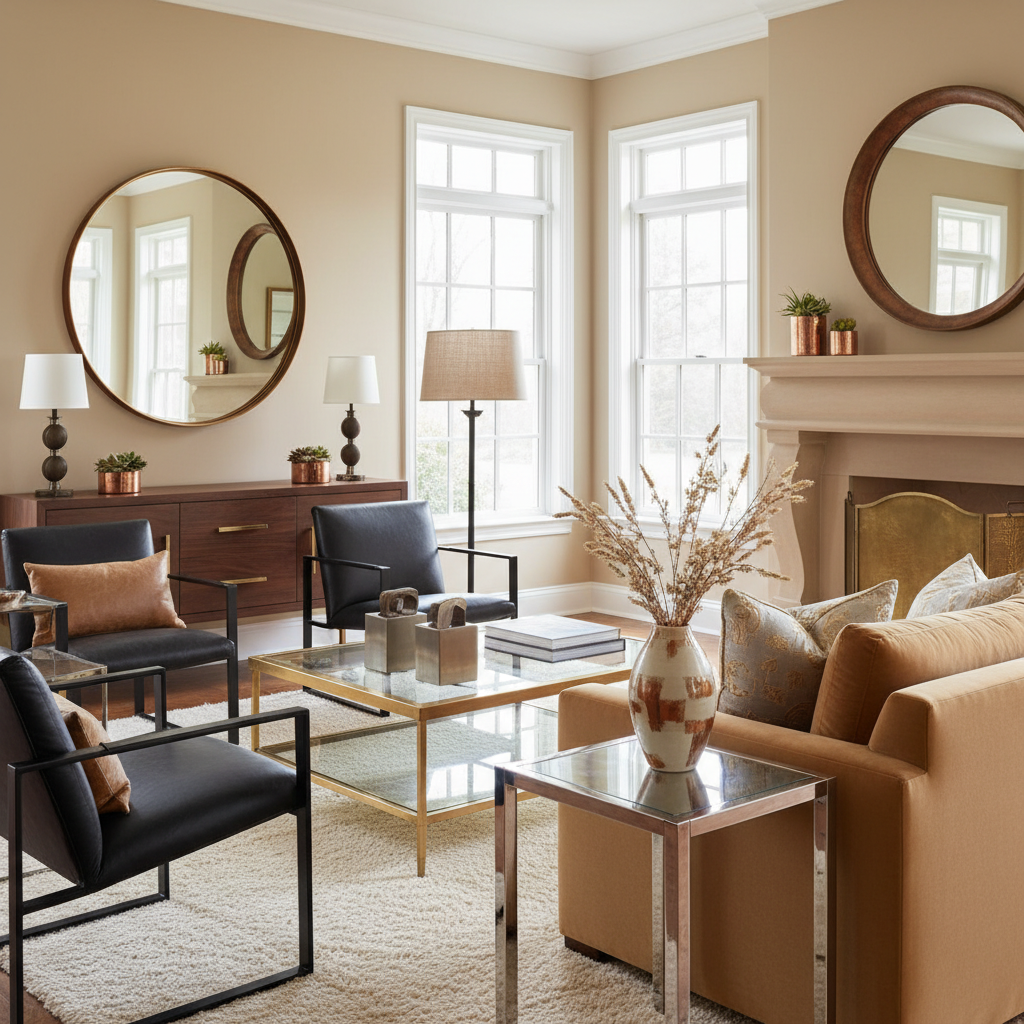
- Dominant Metal (60%): This could be the base of your coffee table, the frame of your primary lighting fixture (e.g., a large chandelier or floor lamp), or the legs of your sofa. For example, a living room with a large, industrial-style coffee table with a matte black metal base could make matte black your dominant metal.
- Secondary Metal (30%): Introduce a warm metal for elegance or a cool metal for modern flair. If matte black is dominant, a brushed brass floor lamp, brass-framed artwork, or brass decorative objects can add warmth.
- Accent Metal (10%): Use small, impactful touches. Perhaps a polished chrome sculpture on a bookshelf, or a pair of small copper candle holders on a side table.
- Example: A living room with a matte black coffee table base and console legs, a brushed brass floor lamp and picture frames, and a polished chrome decorative bowl on the coffee table.
- Tip: Consider the scale of your metallic elements. Large pieces (like a coffee table base) can establish a dominant metal, while smaller pieces (like picture frames) are perfect for secondary or accent metals.
✅ Mixed Metals Checklist for Your Home
✅ Assess Existing Metals: Identify all fixed metallic elements in the room (appliances, plumbing, door hardware). ✅ Choose Your Dominant (60%): Select the metal that will be most prevalent, often dictated by existing fixtures or large furniture. ✅ Select Your Secondary (30%): Pick a complementary or contrasting metal for medium-sized elements (lighting, mirror frames, cabinet hardware). ✅ Introduce Your Accent (10%): Choose a third metal for small, decorative touches (vases, trays, small sculptures). ✅ Consider Undertones: Ensure your chosen metals are a harmonious mix of warm, cool, and neutral. ✅ Distribute Evenly: Spread metals throughout the room at different heights and on various elements. ✅ Maintain Consistency within Finishes: Stick to one finish per metal type (e.g., all brushed brass, not a mix of polished and antique brass). ✅ Use Neutral Metals as Bridges: Matte black or oil-rubbed bronze can help unify warm and cool metals. ✅ Step Back and Evaluate: Does the room feel balanced? Is there a clear hierarchy of metals?
Bedroom: Serene Retreat with Subtle Shine
In the bedroom, metals should contribute to a sense of calm and luxury, often used more subtly than in high-traffic areas.
- Dominant Metal (60%): This could be the frame of your bed, the base of your nightstand lamps, or the hardware on your dresser. A popular choice is a subtle brushed gold or champagne bronze for a touch of warmth and elegance.
- Secondary Metal (30%): Introduce a cool or neutral metal. If your bed frame is brushed gold, consider brushed nickel or matte black hardware on your dresser or nightstands.
- Accent Metal (10%): Small, delicate touches. A polished chrome alarm clock, a small copper jewelry dish, or a silver-leafed decorative box.
- Example: A bedroom with a brushed gold bed frame and nightstand lamp bases, matte black dresser pulls, and a small polished chrome trinket box on the nightstand.
- Tip: Metals in the bedroom can be less about stark contrast and more about subtle layering to create a soft, inviting atmosphere.
By tailoring your mixed metal strategy to each room's specific needs and existing conditions, you can create a cohesive and sophisticated aesthetic throughout your entire home. Remember, the goal is intentionality and balance, allowing each metallic finish to contribute to the overall beauty of the space.
Maintaining Cohesion: Bringing It All Together
The true art of mixing metals lies not just in selecting individual finishes, but in ensuring they all work together to create a unified and harmonious design. It's about orchestrating a symphony of textures and sheens, where each metallic element plays its part without overwhelming the others. Cohesion is the antidote to the "messy" look, transforming a collection of disparate metals into a thoughtfully curated scheme.
The Role of Unifying Elements
Even with a well-planned 60-30-10 distribution, metals can sometimes feel disconnected. This is where unifying elements come into play, acting as visual anchors or bridges that tie the metallic palette together.
- Neutral Metals as Bridges: As discussed, neutral metals like matte black or oil-rubbed bronze are exceptional at bridging warm and cool tones. Because they don't have strong inherent undertones, they can sit comfortably next to brass and chrome, making both feel more at home. Consider using a matte black light fixture that casts light on both a brass-framed mirror and a brushed nickel faucet.
- Non-Metallic Elements: Don't underestimate the power of non-metallic elements to unify your metal scheme.
- Wood: Natural wood tones (light or dark) provide an earthy, grounding base that complements all metals. A wooden dining table can beautifully anchor a mix of brass chandelier, chrome chair legs, and matte black serving trays.
- Stone/Marble: The cool, often veined patterns of stone or marble countertops and backsplashes offer a sophisticated backdrop that can highlight and connect various metals. A white marble vanity can make both polished nickel and antique brass pop.
- Textiles: Fabrics like velvet, linen, or wool in your upholstery, rugs, or curtains can soften the hard edges of metals and bring a sense of warmth and texture. A rich navy velvet sofa can make polished brass accents feel luxurious and inviting, while a chunky knit throw can soften a chrome side table.
- Color Palette: A consistent color palette throughout the room is perhaps the most powerful unifier. If your walls, furniture, and major decor pieces share a cohesive color scheme (e.g., cool blues and greens, or warm creams and browns), the mixed metals will automatically feel more integrated. The metals become part of the overall color story rather than standing out as isolated elements.
Repeating Metals for Visual Flow
Repetition is a fundamental design principle that creates rhythm and visual flow. When mixing metals, strategically repeating each chosen finish in at least two or three different places helps to establish its presence and make it feel intentional.
- The "Rule of Three": Aim to have each metal appear in at least three different spots or on three different types of elements within the room. This doesn't mean three identical items, but three distinct instances. For example, if you're using polished brass as a secondary metal, you might have:
- A polished brass pendant light.
- A polished brass base on a table lamp.
- A small polished brass decorative bowl on a shelf. This repetition ensures that the brass feels like an intentional part of the design, rather than an isolated choice.
- Varying Scale: When repeating metals, vary the scale of the items. A large brass light fixture, a medium-sized brass picture frame, and a small brass accent on a piece of furniture create a more dynamic and layered look than three items of the same size.
- Across the Room: Ensure the repetitions are distributed across the room, not just concentrated in one area. This helps the eye travel and perceive the entire space as cohesive. If you have a brushed nickel faucet on one side of the kitchen, make sure there's another brushed nickel element (like a small appliance or a decorative piece) on the opposite side.
🏠 Recommended Product: Threshold Ceramic Table Lamp With its classic ceramic base and metallic accents, this lamp can easily integrate into a mixed metal scheme, providing both light and a touch of your chosen secondary metal. Buy on Amazon: Threshold Ceramic Table Lamp
Case Study: Modern Farmhouse Kitchen — Before/After
Before: A typical modern farmhouse kitchen with all brushed nickel fixtures. Stainless steel appliances, brushed nickel cabinet pulls, brushed nickel faucet, and brushed nickel pendant lights. While clean, the space felt a bit flat and lacked personality. The white cabinets and light wood floors were beautiful, but the monochromatic metal scheme didn't add any depth.
After: The homeowner wanted to inject more character and warmth while maintaining the farmhouse aesthetic.
- Dominant Metal (60%): The existing stainless steel appliances remained, making stainless steel the dominant cool metal.
- Secondary Metal (30%): All brushed nickel cabinet pulls were replaced with brushed brass pulls. This immediately introduced warmth and a touch of refined elegance. The kitchen faucet was also updated to a brushed brass finish, creating a cohesive brass presence.
- Accent Metal (10%): The brushed nickel pendant lights over the island were swapped for matte black industrial-style pendants. A small matte black decorative tray was placed on the open shelving.
- Unifying Elements: The white subway tile backsplash, light wood floors, and warm gray wall paint provided a neutral backdrop. The matte black pendants acted as a bridge between the cool stainless steel and the warm brass.
- Result: The kitchen now feels layered, sophisticated, and much more dynamic. The brass adds a luxurious touch, the matte black provides a contemporary edge, and the stainless steel maintains functionality, all without looking messy. The mixed metals complement the existing farmhouse elements, creating a richer, more curated space that feels both modern and timeless.
By consciously employing unifying elements and repeating your metals strategically, you can ensure that your mixed metal scheme feels intentional, balanced, and beautifully cohesive. This thoughtful approach transforms a potentially chaotic collection into a sophisticated design statement that truly elevates your home.
Frequently Asked Questions
Q: How many different metals can I mix in one room? A: It's generally recommended to stick to a maximum of three different metals per room to maintain a cohesive and sophisticated look. A good rule of thumb is to choose one dominant metal (60%), one secondary metal (30%), and one accent metal (10%). Going beyond three can often lead to a cluttered or messy appearance.
Q: Can I mix warm and cool metals together? A: Absolutely! Mixing warm metals (like brass, gold, copper) with cool metals (like chrome, nickel, stainless steel) is the essence of a successful mixed metal scheme. The key is to balance them, often by using a neutral metal (like matte black or oil-rubbed bronze) as a bridge to tie them together, or by ensuring good distribution throughout the room.
Q: Should all my plumbing fixtures be the same metal? A: For a cohesive and intentional look, it's generally best for all plumbing fixtures within a single area (e.g., all faucets, showerheads, and drains in one bathroom) to be the same metal finish. You can then introduce different metals through lighting, mirror frames, cabinet hardware, or decorative accessories.
Q: What is a "neutral" metal in home decor? A: Neutral metals are finishes like matte black or oil-rubbed bronze. They don't lean strongly into warm or cool undertones, making them incredibly versatile. They act as excellent "bridge" metals, helping to unify a scheme that includes both warm and cool metallic elements, preventing clashes and adding depth.
Q: Can I mix different finishes of the same metal (e.g., polished brass and antique brass)? A: While possible in very specific, artful contexts, it's generally advisable to maintain consistency within a single metal type to avoid it looking unintentional. For example, if you choose brushed nickel, ensure all your nickel elements are brushed. The variation in your mixed metal scheme should come from introducing different metals, not different finishes of the same metal.
Q: My appliances are stainless steel. What metals can I mix with them? A: Stainless steel is a cool, neutral-leaning metal, making it very versatile. You can easily pair it with warm metals like brushed brass or polished gold for contrast and elegance, or with neutral matte black for a modern, sleek look. Brushed nickel also works well for a softer, cool-toned scheme.
Q: How do I make sure my mixed metals don't look random? A: Intentionality and balance are key. Follow a proportional rule like the 60-30-10 rule, distribute your metals throughout the room (not just in one area), and use unifying elements like a consistent color palette, natural wood tones, or neutral metals to tie everything together. Each metal should have a purpose and a clear presence.
Q: What's a good starting point for someone new to mixing metals? A: Start by identifying the dominant metal already present in your room (e.g., existing appliance finishes, fixed hardware). Then, introduce a secondary metal that offers a clear contrast (e.g., warm with cool) or a neutral metal that complements both. Begin with smaller, easily changeable items like cabinet pulls or decorative accents before committing to larger fixtures.
Conclusion + CTA
Mastering the art of mixing metals in home decor is a powerful way to elevate your space from simply functional to truly sophisticated and personalized. By moving beyond the monochromatic mindset, you unlock a world of design possibilities, adding depth, visual interest, and a curated feel that reflects your unique style. We've explored the benefits of this modern approach, delved into the characteristics of warm, cool, and neutral metals, and provided a practical framework with the 60-30-10 rule for balanced distribution. From strategic placement to avoiding common pitfalls and applying these principles room by room, you now have the tools to confidently blend metallic finishes without your home looking messy. Remember, it's all about intentionality, balance, and creating a cohesive visual story that feels both modern and timeless. Embrace the interplay of different sheens and textures, and watch your home transform into a beautifully layered sanctuary.
Ready to discover your unique home design style? Take the free HomeVibed Style Quiz and get a personalized room-by-room design plan instantly.
As an Amazon Associate, HomeVibed earns from qualifying purchases. This helps support our free content at no extra cost to you.
🏠 Recommended Products for This Style

rugs
Better Homes & Gardens Woven Area Rug
Adds warmth and texture underfoot — the fastest way to anchor a living room.

lighting
Brightech Sparq Arc Floor Lamp
Warm ambient lighting that transforms the mood of any living space instantly.

furniture
Rivet Revolve Modern Upholstered Sofa
Mid-century silhouette with deep cushions — the centerpiece your living room deserves.
Discover Your Home Vibe
Take our free 10-question quiz to get your personalized style report, color palette, and room-by-room design plan.
Take the Quiz